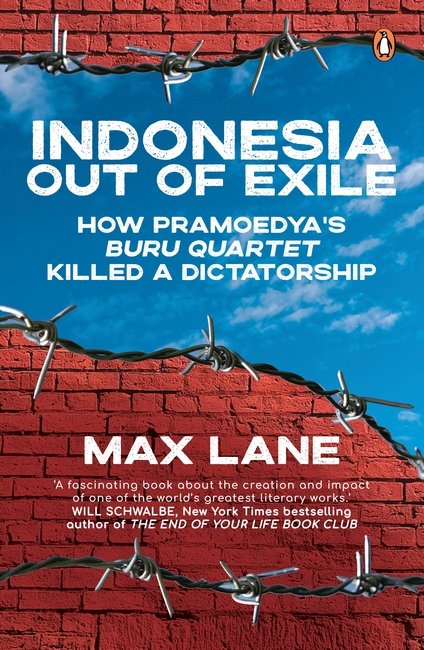
CSEAS UC Berkeley and the Department of S&SE Asian Studies Present: "Indonesia Out of Exile: How Pramoedya's Buru Quartet Killed a Dictatorship + film screening" (March 24, 2023)

Indonesia Out of Exile: How Pramoedya's Buru Quartet Killed a Dictatorship + film screening

Lecture: Center for Southeast Asia Studies | March 24 | 4-7 p.m. | 370 Dwinelle Hall

Speakers: Max Lane; Faiza Mardzoeki

Sponsors: Department of South & Southeast Asian Studies, Center for Southeast Asia Studies

Max Lane is the translator of Pramoedya Ananta Toer's acclaimed quartet of novels written in the prison camp of Buru : This Earth of Mankind, Child of All Nations, Footsteps, and House of Glass. He will discuss his latest book on Pramoedya's important role in bringing down the military authoritarian regime of Suharto's New Order.

The talk will be followed a film screening of "The Silent Song of the Genjer Flowers" - by Faiza Mardzoeki

This is a filmed stage play highlighting the perspectives and experiences of the women survivors of Suharto's violence against Gerwani, the Indonesian Women's Movement allied with the Indonesian Communist Party.

Event Contact: cseas@berkeley.edu, 510-642-3609

Access Coordinator: Sarah Maxim,  cseas@berkeley.edu,  510-642-3609

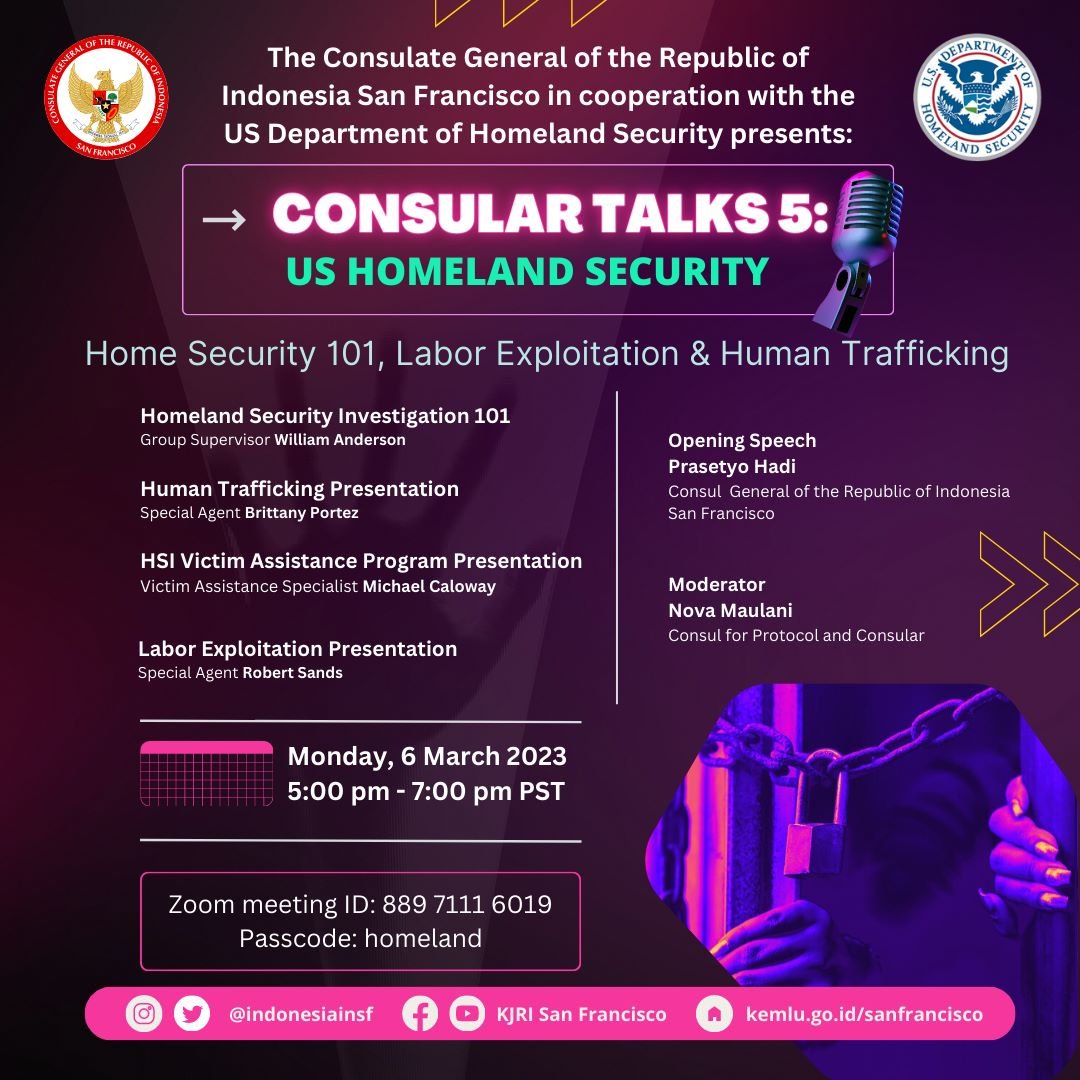
SF Consular Talks: 'Home Security 101, Labor Exploitation & Human Trafficking' (6 March 2023)

Penasaran bagaimana peraturan izin tinggal dan ketenagakerjaan di Amerika Serikat (AS)? Hadiri diskusi interaktif bersama the U.S. Department of Homeland Security dalam acara Consular Talks 5 dengan tema “Home Security 101, Labor Exploitation, and Human Trafficking” hari Senin, 6 Maret 2023 mulai pukul 5.00 PM (PT).

Acara ini akan dibuka oleh Konsul Jenderal Prasetyo Hadi dan menghadirkan empat (4) pembicara berkompeten, yaitu: William Anderson, Group Supervisor, Brittany Portez (US Special Agent), Michael Caloway (Victim Assistance Specialist), Robert Sands (US Special Agent), and penyambut pembicara, Sylvia Tiwon (University of California, Berkeley).

Zoom meeting ID: 889 7111 6019

Passcode: homeland

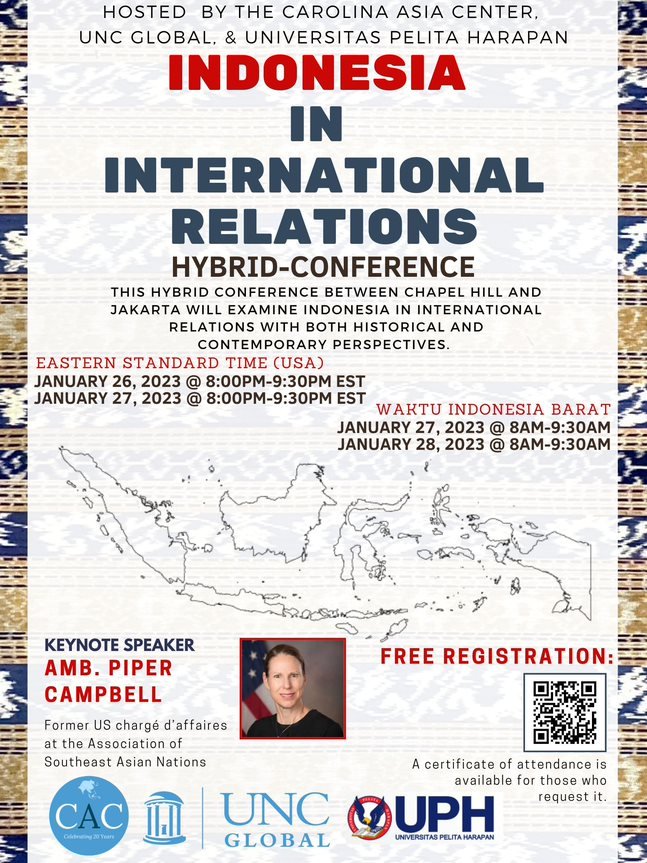
Indonesia in International Relations

Indonesia in International Relations
Friday and Saturday, January 27 and 28, 2023
08:00-09:30 WIB
Room 1609-1610, UPH Graduate School, Plaza Semanggi 16th Floor, South Jakarta or by Zoom (Register here: https://go.unc.edu/indonesia)

Keynote speaker: Amb. Piper Campbell (Former US charge d affaires at ASEAN)
Speakers:
- Prof. Aleksius Jemadu, Ph.D. (UPH
- Dr. Yosef Djakababa (UPH)
- Prof. Dr. James Hoesterey (Emory University)
- Ms. Tsamara Amany (Politician and youth leader)

CAORC-NEH Research Fellowship Deadline Extended to February 6, 2023

The Council of American Overseas Research Centers (CAORC) - National Endowment for the Humanities (NEH) Research Fellowship provides the opportunity for scholars to spend significant time in one country with an Overseas Research Center (ORC) as a research base. AIFIS is the designated ORC for Indonesia. The fellowship supports advanced research in the humanities. Fellowship awards are for four to six consecutive months (i.e. you can hold the fellowship for four, five, or six consecutive months). Selected fellows are awarded $5,000 per month of the award. This program is funded by the National Endowment for the Humanities (NEH) under the Fellowship Programs at Independent Research Institutions (FPIRI).

Summer Intensive Indonesian Language Courses Offered through the Critical Language Institute at Arizona State University

The Critical Languages Institute at Arizona State university is a national training institute for less commonly taught languages, offering summer intensive courses and study-abroad programs around the world.

Every summer, CLI brings students from across the U.S. together to develop their linguistic and cultural competency rapidly and effectively through intensive in-person immersion programs. Students live on the sprawling Arizona State University campus alongside faculty and staff while, speaking, studying, and living in Indonesian.

Arizona State University is a large, metropolitan university. The main campus, housing over 64,000 students, is located in Tempe, 15 minutes by light rail from Phoenix Sky Harbor Airport. Emblematic of the lively, eclectic atmosphere of Tempe is the city's main street, Mill Avenue.

eTropic Call for Papers: "Decolonizing the Tropics"

Special Issue Theme: Decolonizing the Tropics

This special issue aligns itself with the fields of decolonial, anti-colonial, and postcolonial scholarship, and thinks these theories through the critical notion of tropicality. The aim is to rearticulate these fields in tropical terms, that is, with scholarly, applied/engaged, and creative practices from, about, and with the tropical world. This focus is crucial given that current scholarship in postcolonialism and decoloniality still predominantly originates from European/temperate contexts and is primarily informed by Western philosophies and epistemologies. In order to decolonize this status quo, the special issue recognizes not only that colonial systems have profoundly impacted the tropics, but also that neo-colonial power remains an active material reality. This special issue welcomes papers informed by decolonizing intuitions and from scholars of/from formerly and ongoingly colonized regions of the tropics.

Decolonizing the Tropics seeks disciplinary contributions from:

  • Ecocriticism, Multispecies Studies, Environmental Humanities

  • Anthropology, Heritage and Material Studies, Archaeology

  • Post/colonialism and Decoloniality Studies

  • Queer, Gender, and Sexuality Studies

  • Indigeneity and Indigenous Studies

  • Performance and Cinema Studies

  • History and Philosophy of Science

  • Science and Technology Studies

  • Architecture and Urban Planning

  • Feminist and Cultural Studies

  • Gothic and Horror Studies

This special issue centers on three major themes: theoretical engagements with postcolonialism and decolonialization; new vocabularies and vernaculars through which discourses on decoloniality can be initiated; and varieties of practices across disciplinary fields which demonstrate what decolonial tropicality may be – including its entanglement with people, ecology and climate.

We accept writings in disciplinary genres (the scholarly and the creative), and encourage hybrid forms. We also seek submissions engaging material elements—photographs, videos, art, music, theatre, cinema.

CFP Decolonizing the Tropics

This CFP is open to interdisciplinary and transdisciplinary intertwinings, as well as new perspectives on established disciplinary approaches. It invites papers that consider Decolonization of the Tropics through: science and literatures, histories and futures, realities and fictions, mythologies and technologies, knowledges and practices. It invites a wide range of articles and creative works from researchers who engage with the tropical regions of the world: tropical Africa, the Caribbean, Latin America, the Indian Ocean Islands, South Asia, East Asia, Southeast Asia, the tropical north of Australia, Papua and the Pacific Ocean Islands, Hawai’i and the American South.

eTropic: electronic journal of studies in the tropics publishes new research from Arts, Humanities, Social Sciences and allied fields on the variety and interrelatedness of nature, culture, and society in the Tropics. ISSN:1448-2940, free open access; indexed in Scopus, Google Scholar, Ulrich's, DOAJ; archived in Pandora, Sherpa/Romeo; uses DOIs and Crossref; ranked Scimago Q1.  

INSTRUCTIONS FOR AUTHORS

  • Submissions close 30 March 2023 (full paper)

  • Publication date: June 2023

  • Research article submissions should be about 6000-8000 words

  • Literary, creative works and photographic essays about 4000 words

  • Article Titles should be concise and clear (maximum 2 lines)

  • Include a 100-200-word abstract of the article or creative work + 5 keywords

  • Provide a 100-word biographical note for each author (on separate sheet)

  • Strongly follow APA (edition 7) for in-text citations and reference list

  • Contributions should be submitted as a Microsoft Word file

  • Submissions must conform to and be submitted on the eTropic Style Sheet & Layout

  • All images must be used with permission and referenced

  • Submissions should be uploaded to eTropic online journal site

  • Papers undergo a preliminary review to determine if they meet the criteria of the Special Issue

  • Suitable papers will be double-blind peer reviewed

  • If extensive editing is required the author will be notified regarding Professional Copyediting

  • Authors should browse eTropic articles to make sure they are familiar with the journal’s multidisciplinary scope and style

  • For enquiries, or to pitch your ideas or abstracts, email the Editor: anita.lundberg@gmail.com